
Brass Jewelry Wholesale: What Changes at Scale
Wholesale scale in brass is usually described in units, but the number that reshapes a programme is designs. At 100 pieces per design, six designs is 600 units, six moulds and 600 separate inspections. The MOQ stays flat per design while everything around it multiplies.

Key takeaways
- Six brass designs at the 100-piece MOQ commit 600 units and six separate moulds before any reorder.
- 100% inspection is per piece, so 600 units means 600 checks rather than one sample of 60.
- Packaging adds its own unit count: one pouch, one backing card, one tag and one barcode label per piece.
- Sampling can run in parallel across designs; production queues usually cannot.
Tooling multiplies by design, units multiply by quantity
A mould is cut for one geometry, so every design in a programme carries its own tooling. That is why the published minimum is expressed per design rather than per order: 100 pieces of one brass design and 100 pieces of another are two commitments, not one order of 200. A custom brass jewelry OEM programme is therefore quoted design by design, and the buyer's first scaling decision is how many geometries to open.
The two directions of growth behave differently. Going deeper on a design, from 100 to 300 pieces, reuses the existing mould and adds only material, bench time and inspection. Going wider, from one design to six, adds five moulds, five sample approvals and five sets of finish decisions. Depth is cheaper to tool; breadth is what a collection actually needs.
That tension is the central planning problem in wholesale. A buyer with a fixed budget can open fewer designs at a higher unit count or more designs at the minimum. The first route protects margin per unit; the second fills a catalogue. Neither is wrong, but the choice belongs before the moulds are cut, because tooling is the one cost that does not fall when volume rises on a different design.
Inspection is a per-piece cost that never averages out
The published final QC is 100% inspection, which means every piece is checked rather than a sample drawn from the batch. At 100 units that is 100 checks; at 600 units it is 600. The workload grows in a straight line with quantity, and it does not fall when the design is simple, because the check covers the finish, the setting and the plating as well as the dimensions.
Where scale changes the character of inspection is in pattern detection. A single piece with a mark on the back is an isolated catch; the twentieth piece with the same mark is a signal about a polishing pass. A factory inspecting every unit can see that pattern early, which is why the check sits before packing rather than after it.
For the buyer, the practical consequence is that inspection is not a place to negotiate a shortcut on a large run. Reducing the check on 600 pieces saves handling time and pushes the risk into the carton, where the cost of a return is carried by the buyer rather than the bench.
Packaging turns one order into many SKUs
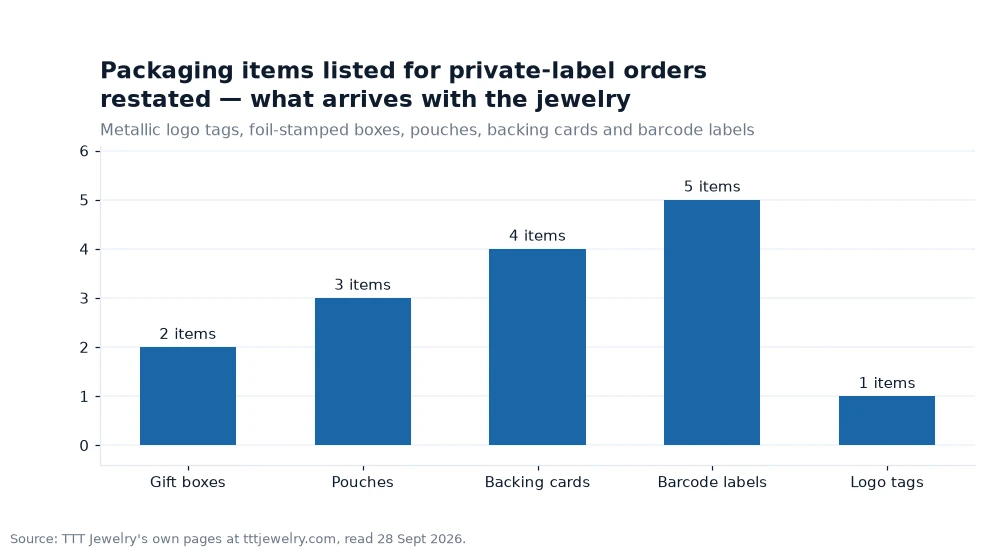
Packing is the stage that most often surprises a first-time wholesale buyer, because the item count is larger than the jewelry count. The published list covers metallic logo tags, foil-stamped gift boxes, velvet or microfiber pouches, display backing cards and barcode labelling. On a 600-piece programme, each of those is 600 units to source, assemble and match to the right design.
Barcode labels are the part that ties the physical order to the buyer's inventory system. A label applied to the wrong pouch is invisible at the factory and expensive at the warehouse, which is why the SKU list has to be fixed before packing starts rather than during it. Backing cards create a similar dependency: a card punched for a hook will not hold a stud, and a card sized for a pendant will not hold a cuff.
Mixed programmes add a sorting step that single-design orders never see. If six designs ship in one carton, the carton must be packed in a known sequence, with each design separated and labelled. That sequence is a document, not a habit, and it should be agreed with the factory at the same time as the purchase order.
| Item | One design | Six designs | What it changes |
|---|---|---|---|
| Units at MOQ | 100 | 600 | Material and bench load |
| Moulds | 1 | 6 | Tooling and sample rounds |
| Sample approvals | 1 | 6 | Buyer review time |
| Pieces inspected | 100 | 600 | QC hours before packing |
| Pouches, cards and labels | 100 each | 600 each | Packing and SKU control |
| Finishes to approve | 1 stack | Up to 6 stacks | Plating scheduling |
The table is a count, not a price list. It shows where the multiplication happens: tooling, approval, inspection and packing each scale with the number of designs, while the published MOQ stays at 100 pieces per design and does not fall as the programme grows.
Plating consistency is the quiet constraint
A larger programme spends more time in the plating tank, and time in the tank is where colour drift appears. Brass takes multi-layer 14K, 18K or 24K gold, or rhodium, followed by anti-tarnish e-coating. Each design may specify a different stack, and each stack is a separate run through the line.
Compliance does not relax at volume. Plating is published as fully compliant with REACH and CA Prop 65, and the materials as free of lead, cadmium and nickel. Those conditions apply to every bath, so a factory cannot mix a legacy process into a large run to save a pass.
Mixed-metal collections compound the issue. Brass runs electrolytic layers, stainless steel runs PVD vacuum plating, and silver runs its own stack with anti-tarnish treatment. A collection that spans all three is three schedules, and the sterling silver jewelry manufacturer page is the place to compare the silver route against the brass one before committing a range.
Worked example
Take six brass designs at the published 100-piece MOQ. Units are 6 × 100 = 600. Moulds are 6 × 1 = 6. Inspected pieces are 600, because inspection is 100% rather than sampled. Pouches, backing cards, tags and labels are 600 each, so packing involves 2,400 items before a single carton is sealed.
Now the calendar. Sampled in parallel, six designs share one 25–30 day window, then 21–28 days of production, plus 2 days of CAD: 48–60 days in total. Sampled one after another, the same six designs need 6 × 25 to 30 = 150–180 days of sampling alone, before production begins. The 100-piece MOQ did not change; only the queue did.
Depth tells a different story. One design taken to 600 pieces keeps one mould and one sample approval, and the 600 units run through a single production window of 3–4 weeks. Compared with six designs at 100 pieces, the unit count is identical and the tooling is one-sixth. That is the trade a wholesale buyer makes between a broad range and a deep single style.
Frequently asked questions
Does the MOQ fall if I order several designs at once?
No. The 100-piece minimum is published per design, so six designs at 100 pieces is 600 units and the threshold applies to each one separately.
Is every piece inspected on a large order?
Yes. Final QC is listed as 100% inspection, so a 600-piece run receives 600 checks rather than a sample drawn from the batch.
Can designs be sampled at the same time?
They can, if the sample bench schedules them together, and that parallel route keeps a six-design programme near the 48–60 day total.
Planning the second order before the first ships
The first wholesale run is mostly a tooling and approval exercise. The second run is where scale becomes routine, because the moulds, the approved finishes and the packaging artwork already exist, and only production and inspection repeat.
Buyers who expect to add a metal to the range should look at the stainless steel jewelry manufacturer route early, since PVD plating follows a different schedule from brass and cannot be slotted into an existing brass run. Mapping the routes before the first order ships is what keeps a growing catalogue from turning into a queue of unrelated deadlines.
Source note: figures come from the manufacturer's own website (tttjewelry.com), read 28 Sept 2026.[1]