
Monitoring a 99 TH/s Rig From Your Phone
A phone alert is only useful if the threshold behind it matches the money at stake. At 99 TH/s, current conditions produce 4.441e-05 BTC a day, worth $3.76 at $84,692 per BTC, or $3.61 after the listed 4% on the block-reward component. A drop of a few terahash is noise at that size; a drop of a whole machine is not.

Key takeaways
- At 99 TH/s, daily output is 4.441e-05 BTC, or $3.76 gross and $3.61 net of the listed 4% on the block-reward component.
- At 990 TH/s the same inputs give 0.00044412 BTC a day, $37.61 gross and $36.11 net.
- The ViaBTC App runs on iOS and Android with real-time hashrate monitoring, alerts and multi-account management.
- An alert should correspond to a machine being offline, not to a normal short-term fluctuation.
The phone is a monitoring tool, not a mining calculator
A monitoring app answers one question well: is the machine doing what it was doing yesterday? It is not the place to decide whether to buy the machine, because the payout depends on network inputs that change independently of the rig. Use the app to catch a failure early, and use the formula to decide whether the rig is worth running in the first place. Keeping those two jobs separate makes both of them clearer.
The reason to monitor at all is that mining failures are often partial. A fan slows, a power supply derates, a board drops out, and the machine keeps submitting shares at a lower rate. The account still shows a balance, so nothing looks broken until the monthly total is compared with the previous month. An alert on reported hashrate catches the change on the day it happens instead of at the end of the month.
What the app shows
The ViaBTC App Download page covers the iOS and Android builds, and the app itself provides real-time hashrate monitoring, alerts and multi-account management. For a small operator, those three features cover most of the day-to-day questions: is the rig hashing, did it stop, and which account is it under.
Real-time monitoring is most useful when it is paired with a baseline. A reported hashrate of 99 TH/s means something only if the nameplate figure is known and the room is at a normal temperature. The app shows the submitted hashrate; the baseline comes from the machine's spec sheet and from a week of observation. Without the baseline, an alert threshold is a guess.
Three rig sizes and their daily figures
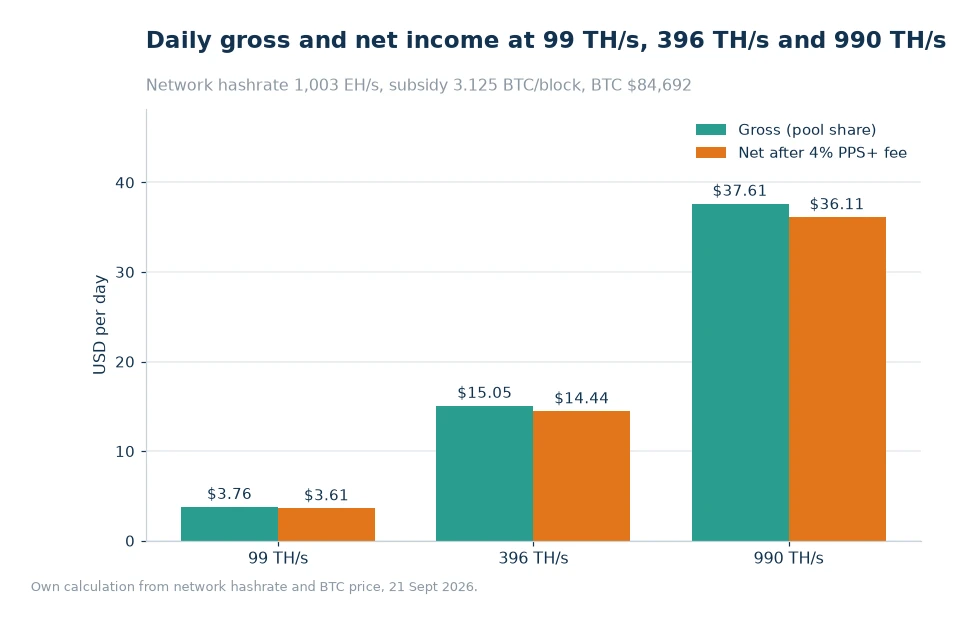
The table gives each size a daily number so the cost of an outage can be estimated. The rows step by a factor of four and then 2.5, and the net column applies the listed 4% to the block-reward component. Power and cooling are excluded, because the app does not measure them and the operator has to.
| Hashrate | BTC per day | Gross USD per day | Net USD per day |
|---|---|---|---|
| 99 TH/s | 0.00004441 | $3.76 | $3.61 |
| 396 TH/s | 0.00017764 | $15.05 | $14.44 |
| 990 TH/s | 0.00044412 | $37.61 | $36.11 |
At 99 TH/s, one day offline costs about $3.61 of net output before power, which is small enough that a single missed alert is not a disaster. At 990 TH/s the same day costs about $36.11, and a week offline is a meaningful sum. The threshold that makes sense for the small rig is not the same as the threshold for the larger one, even though the app looks identical on both phones.
Setting thresholds that mean something
A good threshold is tied to a physical event. If one machine is 99 TH/s, an alert at 95 TH/s catches a partial board failure without firing on ordinary variation. An alert at 99.9 TH/s will fire constantly and get muted, which is worse than no alert at all. The same logic applies to a multi-machine account: set the threshold at the loss of one unit, not at the loss of one percent.
The second threshold is time. A short dip during a difficulty change or a pool switch is not the same as a machine that has been down for an hour. Set the alert to require a sustained gap, then check the app when it fires. The goal is a small number of actionable alerts rather than a stream of notifications that train the operator to ignore them.
Multi-account management for small fleets
A miner with a home rig and a hosted rig may run two accounts, and a small group may run several. Multi-account management keeps them in one app without merging the balances, which makes it easier to compare performance between sites. The comparison is useful: if one site consistently reports a lower hashrate at the same nameplate, the difference is usually cooling or power delivery rather than the pool.
The app is also a convenient place to check a payout after a difficulty adjustment. The next estimate is minus 2.12%, which would raise output per terahash slightly if it holds. A small change like that is hard to see in a single day's balance but easy to see over a week, especially when the hashrate line is stable and only the coin line moves.
Worked example
Take 99 TH/s and run the chart arithmetic with the inputs read on 21 Sept 2026.
- Daily BTC per TH/s is 450 divided by 1,003,000,000, which equals 4.4865e-07.
- Multiply by 99: 4.4865e-07 times 99 equals 4.4416e-05 BTC, shown as 4.441e-05.
- Multiply by the BTC price: 4.4416e-05 times $84,692 equals $3.76 gross.
- Apply the listed 4% to the block-reward component: 4% of $3.76 is $0.15, leaving $3.61 net.
- Multiply by four for 396 TH/s: 0.00017764 BTC, $15.05 gross and $14.44 net.
- Multiply by ten for 990 TH/s: 0.00044412 BTC, $37.61 gross and $36.11 net.
- Thirty days at 990 TH/s nets about $1,083.30 before power, which is the scale at which a sustained outage becomes expensive.
Check the estimate before the alert
An alert tells you that something changed; a Profit Calculator tells you what the change is worth. Run the calculator with the current difficulty and your effective hashrate before setting the threshold, so the number on the phone has a dollar equivalent behind it. Then set the alert at the loss of one machine and leave it alone.
The app is a convenience, not a control system. It cannot fix a blocked intake or a loose cable, and it will not tell you that the room is too hot unless the hashrate falls. Use it to shorten the time between a failure and a visit to the rig, and use the daily formula to decide whether the rig is still worth the visit.
Frequently asked questions
What does the app monitor?
It provides real-time hashrate monitoring, alerts and multi-account management on iOS and Android. It does not replace the pool statement or the power meter, so those remain the source for payout and cost.
How much does one day offline cost at 99 TH/s?
About 4.441e-05 BTC, or $3.61 net of the listed 4% on the block-reward component at $84,692. The gross figure is $3.76, and power would have been saved during the outage.
Should the alert fire on any hashrate drop?
No. A threshold at the loss of one whole machine catches a real failure without firing on ordinary variation. A threshold at a fraction of a percent will produce more noise than useful warning.
Set the threshold at one machine
Write the nameplate hashrate, the daily net and the cost of one day offline on the same note. At 99 TH/s those are 99 TH/s, $3.61 and $3.61. Set the alert at the loss of one machine, check the app when it fires, and keep the formula for the monthly review. The phone is there to shorten the outage, not to replace the arithmetic.
Sources: the ViaBTC download page for the iOS and Android app, and the pool fee schedule for the listed rates. Network hashrate 1,003 EH/s, difficulty 132.76 T, subsidy 3.125 BTC per block, 450 BTC daily and BTC $84,692 were read 21 Sept 2026, published 22 Oct 2026[1]. Every dollar figure is arithmetic on those inputs and moves when they move.